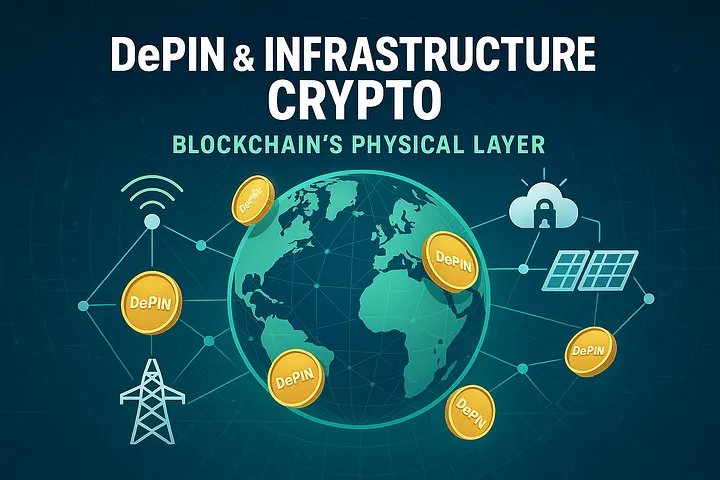
When most investors think of blockchain, they imagine cryptocurrencies, DeFi, or NFTs. But there is a less-hyped sector quietly building the physical backbone of the decentralized economy — and it is attracting serious capital.
The sector is known as DePIN: Decentralized Physical Infrastructure Networks. Powered by infrastructure crypto projects and DePIN tokens, it connects blockchain technology to real-world physical assets — wireless networks, data storage, energy grids, and IoT devices.
For investors looking for stable, scalable, and real-world-tied exposure, understanding DePIN may be one of the more durable theses available in the current cycle — offering both diversification and the potential for passive income.
The bridge between blockchain and the physical world
DePIN refers to blockchain-powered systems where individuals and businesses collectively own and operate physical infrastructure. By integrating blockchain, these networks coordinate globally without centralized control, and participants are rewarded with tokens for contributing the underlying capacity — bandwidth, storage, compute, energy, or data.
The category spans four core verticals:
Why it matters for investors
Unlike purely digital crypto assets, DePIN projects are tied to tangible, real-world use cases. That changes the underwriting equation in three meaningful ways:
- They generate utility-driven demand for tokens, rather than purely speculative demand.
- They tap into multi-trillion-dollar global industries — telecom, energy, logistics — with established revenue pools to disrupt.
- They create genuine passive-income opportunities for participants who contribute capacity to the network.
DePIN is where crypto stops being purely financial and starts looking like infrastructure.
This blend of crypto-native economics with real-world necessity is what positions DePIN as one of blockchain's most sustainable investment categories. Where most token markets struggle to justify themselves outside of trading, DePIN networks produce something measurable — coverage, throughput, kilowatt-hours — whose value compounds independently of cycle sentiment.